For many, the idea of deviating from the typical college route is terrifying, but a growing number of high school seniors are taking those alternative paths. In fact, choosing trade school is becoming more and more popular—and that’s a trend we can get behind. Here, we address what the trade school experience looks like and the doors (or windows) this option opens.
Hands-On Learning Ignites Passion
Gwinnett Technical College is one of the largest trade schools in the state, with over 12,000 students enrolled across 160 programs, from automotive technology and construction to cosmetology and culinary arts, to name a few.
It’s Patrick Mahaffey’s job as the associate vice president of emerging technologies and technical studies to get out into the community and tell students about the opportunities in the trades. He then helps prepare them for new technologies
coming to the industry.
 Patrick Mahaffey Gwinnett Technical College
Associate Vice President of Emerging Technologies and Technical Studies
How did your path lead you into the trades?
Patrick Mahaffey: My grandfather was a small contractor, so I was exposed to the trades from an early age. I went to Purdue for construction management and electrical engineering, but left the industry after a few years. Eventually, I went into teaching. I taught at Berkmar High School from 2007 to 2023. There, I taught the construction classes, which, in the end, brought me back to my original degree and doing what I love.
Which student’s story most inspires other high schoolers?
PM: One student I always talk about started in a work-based learning program, then got hired after his senior year [by Carroll Daniel Construction]. That company does this cohort every two years, where they train six to eight employees to become supervisors, and put them through a commercial construction program at Gwinnett Tech or Lanier Tech. He applied to that and got in. This young man is now 23 years old, has a company truck and is making nearly six figures without ever having to pay a dime for his education.
How much is a technical school compared to a traditional four-year college?
PM: [At Gwinnett Tech], classes are only $107 per credit hour. Most four-year schools charge between $300-$500. Then there’s an additional $478 fee per semester that covers things like the computer labs, security and other services. There’s also the HOPE Grant and HOPE Career Grant, which the state offers for students pursuing high-demand fields.
What are some of the unique opportunities that trade schools offer?
PM: Say you go to a traditional college. You spend the first two years doing all the same stuff you did in high school. Then life happens and you have to leave. What did you get out of those two years? Now, if you come to us, you could earn a certificate, a diploma or an associate’s degree in the same amount of time. I always tell my students — even if you don’t go into the trades, you’re gaining skills you can use in real life and to take care of life.
What advice would you give to students who are considering a career path in the trades?
PM: My advice is to come and see what we do: tour the campus, see our labs. What you’re getting here isn’t just book work, it’s hands-on experience. You can see the real-world applications of your education. We are preparing you for high-demand/high-wage careers.
Proof Is in the Resources
When Suzanne Klarer hired a college consultant to help her son, Evan, she didn’t expect that a traditional college might not be the right fit. After weeks of research and talking with other parents, she realized the real problem wasn’t a lack of options—it was a lack of clarity. So she created SurePath, a consultancy dedicated to helping families navigate alternatives to the four‑year college track.
 Suzanne Klarer
SurePath, Founder
Alongside your experience with Evan, what inspired you to launch this resource?
Suzanne Klarer: The biggest thing I noticed was how scattered the information was. There was plenty out there, but none of it was easy to find or understand. Parents were piecing things together on their own, and there was no single, trustworthy place to turn.
There’s still a lot of stigma around trade schools. As a parent, how did you work through that?
SK: Our entire school system is built around preparing kids for a four‑year college. When your child doesn’t fit that mold, it can feel like something’s off, when really there are incredible opportunities outside that traditional path. There’s a line from a podcast that has really stuck with me: “As a society, we have lifted everyone up in a corner office while we have undermined everyone that built the corner office. That needs to change.”
You mentioned there are a lot of resources out there. Which ones do you recommend?
SK: The Sandy Springs Education Force (sandyspringseducationforce.com) hosts a high‑demand career fair every year at Riverwood High School. And families should absolutely check out Skilled Nation (skilled-nation.org), which provides financial scholarships for students pursuing the trades.
And what about Evan—has he made a plan?
SK: He has! He’s chosen the HVAC track and will start at Gwinnett Tech in the fall. He’s already working part‑time at Sosebee Services, a local HVAC company. So this summer, he’ll be in 100‑plus‑degree attics, learning what the work really feels like—not just the technical skills.
Students Sound Off
 Emily Escobar
Student
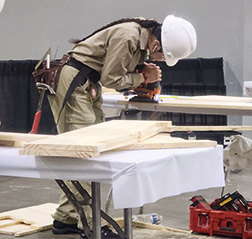
Emily Escobar is a 20-year-old student majoring in Residential Construction Management at Gwinnett Technical College. Her goal is to earn her general contractor’s license and grow her family’s business.
How did you get interested in the trades?
Emily Escobar: My parents own an interior renovation company. Over time, I realized that I wanted to help expand the business. A major motivation for me is being able to create a better future for my family and give back to the people who have worked so hard for me.
What unique opportunities do you have by choosing trade school?
EE: One of the biggest opportunities this path has given me is the ability to gain real-world experience early in my career. Through trade school and hands-on learning, I have been able to develop practical skills, build connections and prepare for a career with strong growth opportunities.
What advice do you offer others considering this career path?
EE: Construction is a field that rewards hard work, dedication and a willingness to learn. Whether you are a man or a woman, there is space for anyone passionate about the trades. Stay confident, ask questions and take every opportunity to learn from others in the industry.
 Makayla Howell
Student
Makayla Howell is a freshman at Gwinnett Tech, majoring in Residential Construction Management with the goal of a career in estimating. She took a dual-enrollment class in CAD drafting as a high school sophomore, which kick-started her interest in construction.
What is it about estimating that interests you?
Makayla Howell: I love numbers and my first construction class was an introduction to construction management. The instructor was an estimator in historic reconstruction. She would use her projects as examples in class, and once she noticed my interest, she would walk me through more of her projects.
What do you enjoy most about going to school here?
MH: I’m a year into my pathway, and I have been able to shadow contractors on their projects to really get an understanding of what I am signing up for. Each time, I am more sure this is what I want to pursue.
What advice do you offer others considering this career path?
MH: Talk to your classmates and instructors! There are so many connections out there you can make just by talking to the person sitting next to you. Also, try everything. There are various routes you can take in the construction pathway, so take every class you can and find what really piques your interest.
Gwinnett Tech offers classes at its Lawrenceville and Alpharetta-North Fulton campuses supporting a wide range of programs. For a complete list, visit gwinnetttech.edu/programs.
Going Green
 Mary Kay Woodworth
Georgia Urban Ag Council (UAC) Executive Director
Building and construction isn’t the only trade industry with opportunities for greener pastures. From turfgrass producers and greenhouse managers to arborists and landscape designers and architects, Georgia’s billion-dollar urban agriculture and green industry also offers plenty of room for career growth. Mary Kay Woodworth, the executive director of the Georgia UAC, tells us what kinds of growth opportunities exist there.
What is the Georgia UAC and what does it do?
Mary Kay Woodworth: It’s the premier professional association for Georgia’s urban agriculture industry. Our mission is to fuel industry growth by strengthening professional standards, providing high-quality education and advocating for the environmental and economic benefits of urban agriculture. Essentially, we ensure that the people who design, install and maintain Georgia’s landscapes are highly skilled, ethically sound and environmentally responsible.
It sounds like there’s more to the industry than mowing lawns. What are some lesser-known, high-demand careers in urban agriculture?
MW: There are several specialized roles that are desperately seeking talent. There are irrigation and water management specialists who design smart systems to use water efficiently and reduce waste. Arborists and urban foresters are experts in tree health and safety, a vital service for Atlanta’s “City in a Forest” reputation. Interiorscape technicians are responsible for designing and maintaining indoor plant environments for offices and hotels. Turfgrass managers are essential for Atlanta’s stadiums and many golf courses. And landscape estimators are math-heavy roles that help calculate the costs and materials for large-scale commercial projects.
How can students get into the industry? Are there any beneficial licenses or certifications to pursue?
MW: Looking into technical schools is a good start, like the environmental horticulture programs at Chattahoochee Tech and Gwinnett Tech. The local UGA Extension offices also offer a large variety of continuing education programs and certifications. There are also industry education events like our Landscape Pro University. As far as beneficial certifications, those depend on your industry.
What does the future of the industry look like?
MW: We’re seeing a shift away from manual labor to focus on precision management. Automations like robotic mowers and self-driving tractors are already hitting the market. A big trend we’re seeing right now is sustainable and climate-resilient landscaping, which is more resilient than traditional decorative landscaping. Water is the organizing principle of all life. By shifting from a reactive “drainage” mindset to a proactive “catchment” design, we can protect our high-value assets (like trees) and build landscapes that thrive even in the face of a changing climate.
Read the original article here: https://atlantahomeimprovement.com/trade-school-a-pathway-beyond-the-four-year-tradition/