
UGA’s Center for Urban Agriculture supports green spaces in Georgia
By:
Georgia's cities are buzzing with ideas.
In places where space is tight and ideas are big, the UGA Center for Urban Agriculture helps Georgians create landscapes and training programs to keep their communities thriving.
The pattern is familiar: A crossroads becomes a town, a town becomes a city, a city sprawls into what was once farmland.
Of Georgia’s 159 counties, 35 are now classified as urban or suburban. According to U.S. Census Bureau estimates, Georgia’s population is about 11.3 million. Since 2000, the state’s population has grown by 1.5 million as people continue to relocate for jobs, affordability, mild winters and long outdoor seasons.
Consistently ranked among the fastest-growing states in the nation, Georgia offers a wide geographic and cultural range, quality roads and global connectivity through the world’s busiest airport.
Growth brings jobs, schools and hospitals — the infrastructure of functioning societies. It also demands attention from planners, growers, homeowners, educators and local leaders who care about what their communities become.
This is where the mission of the University of Georgia Center for Urban Agriculture (CUA) comes into focus. The center was created to strengthen how the university supports agriculture and natural resource management in cities and suburbs — places where population density, land use and environmental pressures shape how food is grown and landscapes are managed.
Extension in the city
While UGA Cooperative Extension has long served Georgians in both rural and urban communities, the nature of those relationships has differed. In rural areas, county agents often work with families and farms across generations. In urban counties, where communities are larger, more transient and less directly tied to production agriculture, those connections have not always been as familiar or as visible.
“Two-thirds of Georgians live in just 25 counties, and their agricultural needs look different from those in rural areas,” said Mike Toews, associate dean for Extension at UGA’s College of Agricultural and Environmental Sciences. “But our mission remains the same — to serve the people of Georgia, no matter where they live.”
Housed on UGA’s Griffin campus, about 40 miles south of Atlanta, the Center for Urban Agriculture serves as a hub, bringing together faculty from CAES, the College of Family and Consumer Sciences, the Warnell School of Forestry and Natural Resources, and Georgia 4-H with expertise in food production and nutrition, landscaping, turfgrass, urban forestry, pest management and youth development.
That expertise doesn’t stay centralized. Faculty work closely with Extension agents, providing research-based training and technical support that agents carry back to the communities where they live and work.
Under the leadership of Director Bethany Harris, the center helps connect the university with municipalities, professional organizations and industry groups so Extension is included in conversations about land use, water management and urban ecosystems.
Urban agriculture is not just about producing food in small spaces. It’s about addressing environmental challenges, supporting landscape professionals and creating community spaces that connect people to nature.”
“A huge part of what we do is listen,” Harris said. “Our goal is to connect the challenges of our growing communities with the right research, faculty expertise and Extension programming."
In that way, the center strengthens a familiar Extension model for a changing state, ensuring that as Georgia’s cities grow, they remain connected to the systems that sustain them and the people who steward them.
Resilient community growth connects people, resources and research
Since becoming director of the Center for Urban Agriculture, Harris has taken a deliberate approach to expanding the center’s visibility by strengthening ties with national associations, pursuing partnerships across public and private sectors, and building targeted education programs that respond to emerging needs in Georgia’s agricultural industry and food systems.

Center for Urban Agriculture's Director Bethany Harris. September 26, 2025.
A Triple Ag Dawg, Harris earned a bachelor’s degree in environmental resource science in 2013, a master’s degree in entomology in 2015 and a doctorate in horticulture in 2018.
Conferences like the Cut Specialty Flower Grower’s Conference bring together researchers, growers and entrepreneurs for applied research, peer learning and collaboration.
To provide tools for people of various skill sets, Harris and her team are expanding online course offerings for industry professionals and the public to make credible, research-based guidance available to all Georgians.
Beautiful lawns start underground: Root health is key to a sustainable yard
Turfgrass may be the most common landscape feature in Georgia and one of the most intensively studied. At the Center for Urban Agriculture, turfgrass scientists examine how lawns function as living systems.
Extension Turfgrass Specialist Clint Waltz often describes himself as a “turf nerd,” focused on what happens below ground. Decades of research have produced turf varieties that require less water, resist disease and tolerate heavy foot traffic. But genetics alone don’t determine whether a lawn is sustainable — management matters just as much.
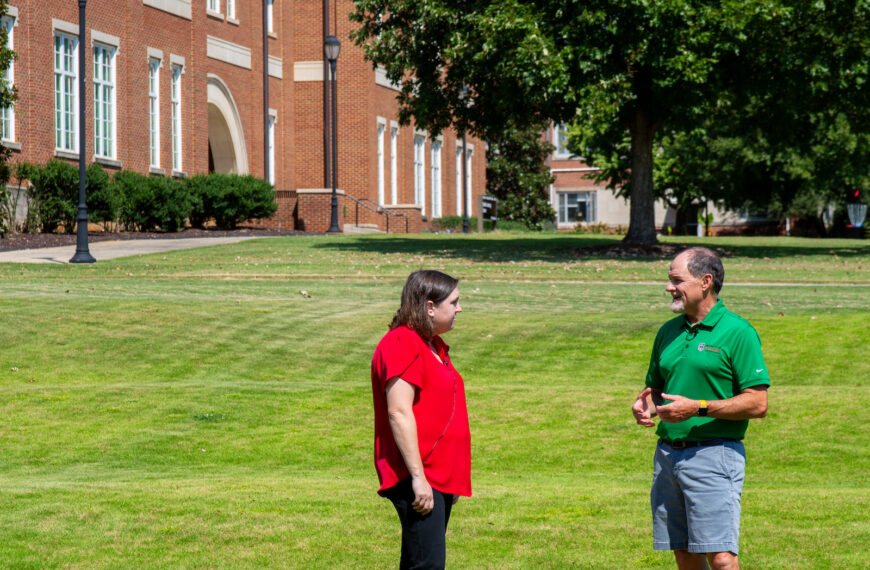
Bethany Harris, the Director for the Center for Urban Agricultures speaks with Turfgrass Extension Specialist Clint Waltz about robotic automowers and the scientific benefits they provide for turfgrass. September 16, 2025.
By pairing improved turfgrass varieties with smarter management tools, researchers are redefining how lawns fit into sustainable landscapes.
Most homeowners mow once a week or less. Waltz is studying a different approach using autonomous mowers that clip grass lightly and frequently. The change is subtle above ground but significant below it. Continuous mowing encourages deeper, denser roots, increasing the plant’s ability to access water and nutrients.
Deeper roots translate to lower water demand, especially during hot summers when irrigation systems are pushed to their limits.
The benefits extend beyond water conservation. Automated mowing reduces labor demands in an industry facing persistent workforce shortages while supporting healthier turf that recovers more quickly from stress.
“In Georgia, if we can get from one rainfall event to the next without turning on irrigation, that’s meaningful,” Waltz said.
In a flow state: Water-wise practices keep cities green and healthy
Pressured by population growth, development and agriculture, freshwater is among the most strained resources in the country. Yet property values are often tied more to curb appeal than conservation, said Rolando Orellana, UGA Extension’s urban water management agent. UGA researchers and Extension faculty show that beautiful landscapes and responsible water use can coexist.
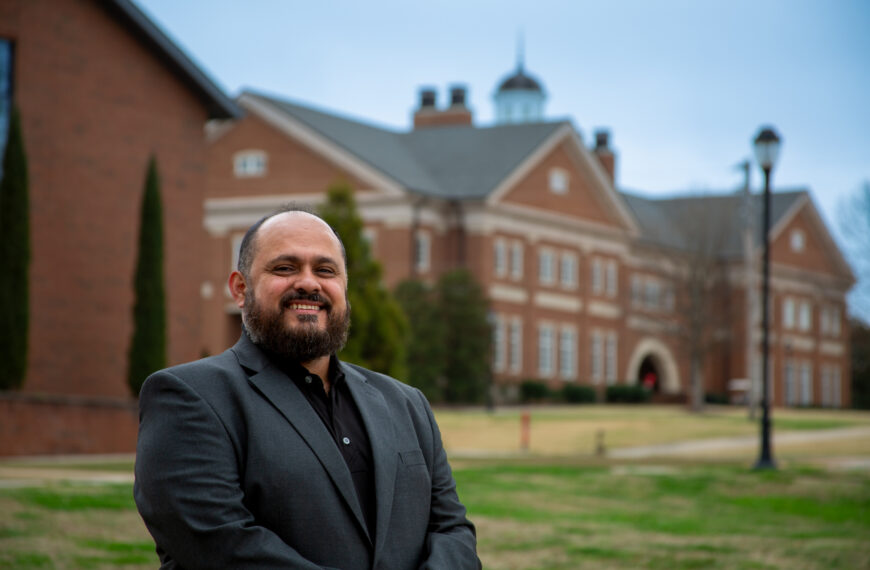
Rolando Orellana, Urban Water Management Agent within the Center for Urban Agriculture.
At UGA-Griffin, Orellana leads the state’s first irrigation demonstration plot, which focuses on improving the efficiency of landscape watering. Coordinated with the landscape industry and professional associations, the site shows how smart irrigation controllers respond to real-time weather and soil moisture conditions. The result is healthier landscapes that use less water while reducing costs for homeowners and municipalities.
Separate from his irrigation work, Orellana collaborates with Northeast District Area Water Agent Martin Wunderly, Associate Professor Gary Hawkins and the Georgia Environmental Protection Division on a stormwater green infrastructure demonstration site that focuses on managing rainfall where it occurs.
As development expands, stormwater that once soaked into the ground now carries sediment, trash and pollutants into streams and rivers. To counter those effects, the team trains landscape professionals using practices such as pervious concrete and pavers, French drains and green roofs.
Structural pest management program trains Georgia’s pest control professionals to keep unwanted roommates in check
Pest management looks different when insects cross from natural systems into built environments. In fields and forests, insects are part of functioning ecosystems. In homes, schools and businesses, they raise concerns about structural damage and human health.
That’s the focus of UGA’s Structural Pest Management Program, led by Dan Suiter, Orkin Distinguished Professor in Urban Entomology.
The program provides research-based training for Georgia’s pest control industry, preparing professionals to manage pests where control options must balance effectiveness with safety.
Through courses at UGA-Griffin’s Structural Pest Control Training Facility, practitioners learn to identify pests, assess risk and apply management strategies grounded in current science. This program works with the Georgia Department of Agriculture’s Structural Pest Division, supporting state licensing and certification.
The center also supports “Getting the Best of Pests,” a webinar-based professional education series that draws hundreds of attendees nationwide each month. The program offers 18 webinars annually, featuring experts from land-grant universities. Revenue is reinvested in county Extension efforts, directly supporting local programming.
These efforts help protect public health, property and quality of life as Georgia’s built environments expand.
Georgia Certified Landscape Program strengthens Georgia's green industry
A vast green industry shapes Georgia’s landscapes in nearly every community. The sector, which includes nursery and greenhouse production, sod farms, landscape services and garden retail, consistently ranks among the state’s top commodities. In 2022, ornamental horticulture generated more than $1.28 billion in farm-gate sales, making it Georgia’s third-largest agricultural commodity, behind broilers and cotton.
Urban developments, suburban neighborhoods and rural communities all depend on the same supply chains, expertise and skilled workforce. As demand has grown, so has the need for trained professionals who understand plants, soil, water and pest management.
Workforce development is a core focus of the Center for Urban Agriculture. Through certification and training programs, landscapers, nursery professionals and crew members across Georgia have access to professional advancement without requiring a four-year degree.
The Georgia Certified Landscape Professional and Georgia Certified Plant Professional programs, developed in partnership with the Georgia Green Industry Association, prepare professionals to manage landscapes responsibly.
“Cities depend on landscapes that are both beautiful and resilient,” said Melba Salazar Gutierrez, coordinator of both programs. “These programs give industry professionals the tools they need to support plant health and long-term landscape performance.”
