The Future of Runoff: Inside the New Green Stormwater Infrastructure Demo Site at UGA Griffin
By:
As growers, landscape contractors, and suppliers, you know that stormwater management is no longer just a checkbox on a site plan—it is a critical driver of modern landscape design. Clients are increasingly demanding sustainable, low-impact development solutions that handle heavy rain where it falls.
To give Georgia’s green industry a hands-on look at the cutting edge of these practices, the UGA Urban Water Management Team officially cut the ribbon on the brand-new Stormwater Green Infrastructure Demonstration Site, located at the beautiful UGA Research and Education Garden on the Griffin campus.
Supported in part by EPA Section 319(h) grant funding through the Georgia Environmental Protection Division (EPD), this newly minted site isn’t just an educational tool for the public—it’s a real-world testing ground and reference site for industry professionals.
A Round of Applause for Industry & Academic Leaders
Bringing a comprehensive demonstration site like this to life requires an immense amount of cross-agency collaboration, vision, and hard work. The ribbon-cutting ceremony drew an impressive lineup of leaders from academia, government, and the private sector who deserve immense credit for driving this project across the finish line.
Special thanks and accolades go out to:
- Dr. Nick Place, Dean, College of Agricultural and Environmental Sciences (CAES), UGA
- Dr. Jeffrey Dean (Campus Director & Assistant Provost) and Dr. Mike Toews (Associate Dean for Extension), providing critical institutional and research leadership at UGA
- Brian Kent of the Nonpoint Source Pollution Program at the Georgia EPD, representing the vital regulatory and funding partnerships that back these initiatives
- Dr. Brad Gaolach of Washington State University and the National Urban Research and Extension Center (NUREC), showcasing the national reach and academic collaboration behind this project
- Rolando Orellana and the rest of the UGA Urban Water Management Team, who put in the boots-on-the-ground work alongside dedicated industry partners like Grandiflora, Horizon Roofscapes, and Moreno Landscape (UAC member) to design and build the site.
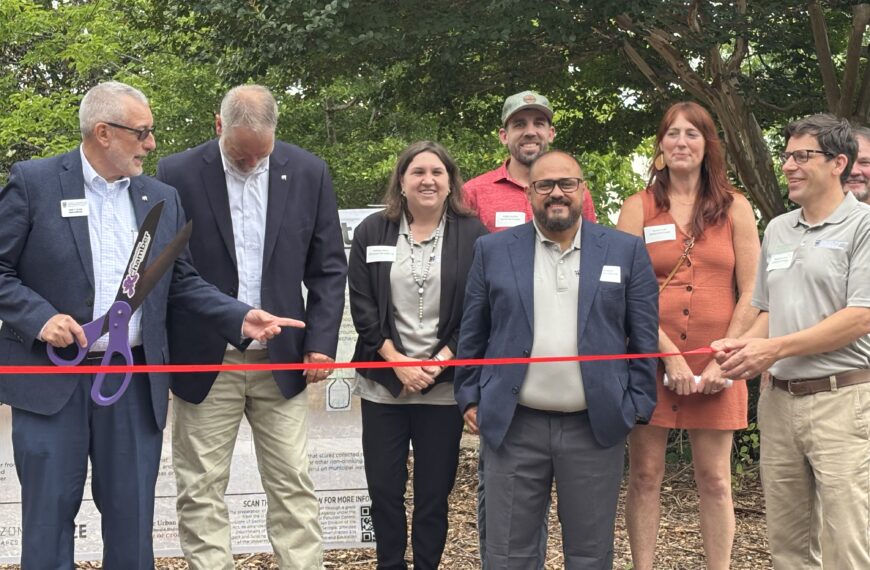
From left, Dr. Nick Place, Dr. Mike Toews, Dr. Bethany Harris, Rolando Orellana, Robby Jourdan and Rachael Auld of Horizon Roofscapes at the ribbon cutting ceremony.
The 9 Stops: A Masterclass in Stormwater Techniques
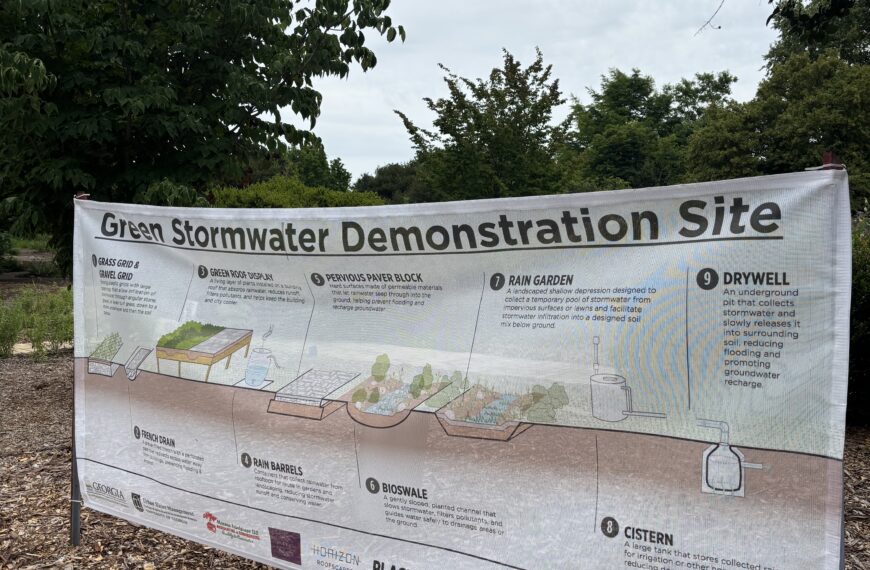
For landscape contractors and suppliers, the real draw of this facility is the 9-stop walking tour. Each stop downhill replicates a drop of water’s natural journey, demonstrating a different green stormwater practice from source capture to underground infiltration.
Here is a summary of the techniques being displayed, complete with professional-level design specifications accessible on-site via QR codes:
- Grass & Gravel Grid: A look at stable, high-traffic permeable surfaces that eliminate traditional asphalt runoff while maintaining structural integrity.
- French Drain: A classic technique showcased with modern installation standards, proving how subsurface water can be efficiently redirected before causing site damage.
- Green Roof Display Table: Complete with a rain simulator and native sedum plantings, this display offers an up-close look at how vegetated roofs capture and retain rooftop rain.
- Rain Barrels: Demonstrating the simplest first-tier method for residential or light commercial clients to intercept roof runoff.
- Pervious Paver Block: An interlocking permeable concrete paver walkway that showcases how architectural beauty can effortlessly blend with rapid sub-base infiltration.
- Bioswale: A living, sloped channel engineered with native plants and strategically placed boulders designed to slow down, filter, and clean high-velocity water as it flows.
- Rain Garden: A beautifully landscaped basin combining engineered soils and native root systems to maximize soil recharge and pollutant filtering.
- Cistern: For larger residential and commercial projects, this 200-gallon installation models the infrastructure needed for high-capacity rainwater harvesting and controlled reuse.
- Dry Well: An underground, stone-filled excavation demonstrating how to store large volumes of runoff beneath the surface and gently return it to the water table.
How to Leverage This Site for Your Business
Whether you want to see how different permeable pavers hold up, check out the specific native plants thriving in the engineered bioswales, or view the technical layout of a dry well, this site is built for you.
- Bring Clients & Teams: The site is open to the public during daylight hours at the UGA Griffin Campus. It serves as an excellent living showroom to show clients what a rain garden or pervious paver path looks like in real life.
- Access Technical Blueprints Remotely: If you can’t make it to Griffin in person, the entire project has been digitized. By visiting urbanstorm.org, green industry professionals can access technical specifications, design drawings, downloadable resources, and practical guidance to directly implement these exact techniques on your next project site.
Congratulations to the entire UGA and Georgia EPD teams on launching a resource that will undoubtedly elevate the standards—and the opportunities—for Georgia’s landscape professionals!