Providing holiday lighting services to commercial and residential customers is a multiple step approach.
To ensure the work is worthwhile, companies need to not only track its profitability but stick to a tight schedule and plan ahead for the inevitable calls from clients when a light isn’t shining bright.
Not only are clients expecting lights, but they also want wreaths, garland and other décor to get them in the festive spirit.
It adds up though. Shorb Landscaping of Kensington, Maryland, did about $40,000 in holiday work with only about $7,000 specific to lighting, says Senior Landscape Design Consultant Scott Warnick.
“We’re doing live greens, roping, planter pots — everything,” he says. “For commercial and residential clients, we’ll wrap trees with lights. We’re really just starting out with the lighting.”
In Saginaw, Michigan, the Garpiel Group is doing nearly half a million in holiday lighting work annually.
“Last year we did $500,000 in Christmas lighting,” says Alexis Straebel, sales coordinator. “It’s crazy to think we did that as this is one of our smaller divisions…but to produce that volume of numbers in a small timeframe is commendable. I like to brag about that.
“It is advantageous for folks to add it in to their business as an add-on service,” she adds.
For Dennis’ Seven Dees Landscaping and Garden Centers, in Portland, Oregon, Sean Snodgrass also says holiday lighting can be a profitable add-on service.
“We only do about $250,000 worth of it annually, which if you look at our urban plantscapes division we do $1.5 million total,” he explains. “It is profitable…we offer our commercial clients what they need. Someone is going to do it for them, so we want to be able to offer as many services as we can for them.”
Built-in busy work
Another advantage of having holiday lighting as a service is it keeps crews around longer, Snodgrass notes.
“We’ve been offering the services for probably 20 years or so, it’s always been a part of our business model,” he says. “We have snow and ice as well, but we’re looking for everything we can do to keep our guys busy and employed, since we don’t use H-2B, and holiday lighting is one of those avenues.”
Snowflakes can be fickle in Michigan — with some years amounting to great snow seasons and others not so much — so, Straebel says holiday lighting is guaranteed work for Garpiel Group’s crews.
“Why we even started doing it a number of years ago was to keep our team busy longer given the seasonality of Michigan,” she says. “Once the frost comes and we stop putting patios and construction in the ground it became, ‘how do we keep team members busy?’
“In between snowstorms, we’ve found taking down the lights helps keep a few of our team members busy,” Straebel adds.
A tight timeframe
What may be the most challenging element of providing profitable holiday lighting and décor services is how quickly the window of opportunity comes and goes.
“You have to think about the logistics,” Warnick advises. “The calendar is your best friend. There’s such a condensed window of time.”
That’s why businesses must market it early. Not only to their existing client base, but any new customers as well.
“We’ll do an email blast and send out a one-page document and then in our email signatures we always have seasonal reminders, so we throw holiday décor into that too,” Warnick says. “We’ll take on new clients through the advertising that we do, but since it’s so seasonal and a condensed window…we really do try and stick to our existing clientele; just because it’s already a challenge to get everything done on time.”
That’s why Straebel says she strives to start the process early.
“We do Christmas in July which was a crazy concept at first for our leaders to wrap their heads around,” she admits. “Now we start advertising in July and getting all of our renewal agreements together. We start talking with HR to see how many people on the team have done lights before and what our needs are on the labor side of things to achieve our goals.”
Garpiel Group is also responsible for the holiday lighting for the city of Frankenmuth, which is a famed Christmas Bavaria in Michigan.
“Given the seasonality of the business, people don’t love seeing their Christmas lights go up in September usually, but we start installing then, and go until the first or second week of December,” Straebel says. “We welcome new customers, and that’s where planning early comes into play. If people allow us to install earlier, we’ll offer promotions or discounts.”
Straebel, Snodgrass and Warnick are all in different markets, but they all say the timeline in which their clients want their lights and décor installed is all the same.
“People don’t want the lights on their building too long not lit but everyone wants them the day after Thanksgiving. It’s a logistical challenge to get everyone installed in time and turned on in time. And keep everyone happy,” Warnick says.
That means crews are working overtime, and Straebel suggests doing everything you can to show them appreciation during this stressful time.
“Thanksgiving night is the big night where folks want their lights on,” she says. “So, I always call the week of Thanksgiving ‘Hell week.’ But it’s a week of opportunities. The team knows they’re going to get breakfast and lunch from us and be well taken care of for the 12-hour days they’re putting in.”
Checklist common challenges.
Not only are businesses up against the clock to get everything installed in a tight timeframe, but there’s plenty of other challenges associated with holiday lighting and décor work.
“There’s tons,” Snodgrass simply says. “Pricing itself can be a challenge with all the tariffs and taxes and things.”
Budgets have been a big issue as of late, Snodgrass adds.
“Budgets, especially for commercial clients, are not what they used to be. How do we get creative with trying to give them that holiday décor they want but at a reasonable price, while still offering a quality product and turning a profit,” he explains. “That’s been the biggest push-pull we’ve had with it lately. More than anything we get questions asking, ‘What can you do with the same budget as last year?’ or ‘We want more for less.’”
Snodgrass says the holidays always add another layer of emotion to the work as well. Which means customer expectations are naturally higher.
“There’s more emotional expectations,” he says of holiday lighting compared to other services. “They have a vision in their heads of what Christmas looks like. They have emotional ties to the holiday and much more opinions, which leads to extra touches, feedback and maybe some handholding.”
When deciding to add holiday lighting, Warnick says the first challenge can be determining your pricing and renewal structure.
“There’s a ton of challenges,” he says. “Are you going to sell the service via a contract? Or as a one-time thing? I think it’s beneficial to sell contracts because you need that early commitment from the client to buy your materials early. All this stuff runs out like crazy.
“We early order our live greens and try to advance purchase all that we can,” Warnick adds.
All three say most of their work is on an extended contract basis — but that doesn’t make life much easier.
“If you go the contract route now you have to store the lights,” Warnick notes. “Typically, the higher-grade lighting can last a few years so it’s not just a throwaway. Now you have thousands of strings of lights that need to be stored and labeled and delivered back each year. Storage is always a concern.”
Then once the lights are up — businesses can count on customers calling at least once to report an outage.
“Service calls are inevitable,” Warnick says. “A couple of strings won’t go on, or somebody blows a fuse, so you have to have a provision for service calls in your contract. Maybe some can be included but some have to be billable visits.”
Straebel says Garpiel Group works those calls into their contracts.
“We build a service call into the package, and the clients really see value in it,” she adds.
For her, Mother Nature brings its own set of hurdles to jump through.
“People are making a big investment in this, and we want to make sure it’s top-notch and working as much of the time as possible,” she says. “When we start, we’re dealing with rain, and then the freezing temperatures come and that moisture can cause some trouble. So, the weather can be a challenge, but repairs are inevitable. You have to have enough team members and willpower to get to those calls within 24 hours.”
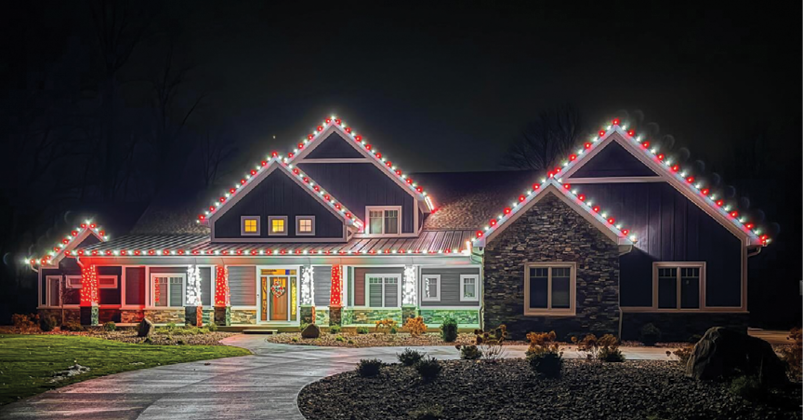
Given the tight timeline of the holidays, Michigan’s Garpiel Group offers discounts and promotions for customers willing to have their lights and decor done early. PHOTO COURTESY OF Dennis Seven Dees
Be the spirit of Christmas
At the end of the day, what it takes to make holiday lighting a successful service is simple, Snodgrass says. It’s passion.
“Find someone who is passionate about it,” he says. “You need a champion for holiday services. If you have a team that’s just doing it to stay busy and aren’t passionate about it — the product isn’t going to shine and the emotion behind it won’t show.
“Find someone with a detailed eye who can adjust some bows and make things by hand and really put some blood, sweat and tears into it,” he adds. “It’s a lot of work and a lot of stress with a lot of expectation happening really quickly. There’s a lot of problems that’ll need to be solved on the fly, so you need someone who’s the leader and loves challenges and is excited about it.”
Rewarding that hard work is also needed. That’s why Straebel says everyone gets a little relief after the holiday season.
“After Christmas we usually give the team a well-deserved two-week break because they’ve put in some crazy hours,” she says.
And Straebel also stresses the importance of putting passion into the work and the division as a whole.
“Start by treating it as its own, professional division,” she advises. “When I first started it always seemed like the red-headed stepchild division. You took who you could get and there wasn’t motivation to grow it. But I stepped in and said, ‘If you see the opportunity in it, you’re going to get a return out of it.’”