
I couldn’t wait to get my hands on the Shadowland Giant Lone Star hosta. I don’t believe this hosta was discovered in the shady soil under a Texas Madrone in Guadalupe National Park. It was actually a morphological change in a hosta named Key West. That sounds like a fairy tale story all its own.
But Shadowland Giant Lone Star has “winner” written all over it. It is large and has thick leaves. When 12 straight days of rain brought out a rainforest of slugs and other forest floor creatures, to the bane of hosta growers everywhere, it didn’t load up with holes. It simply got more beautiful.
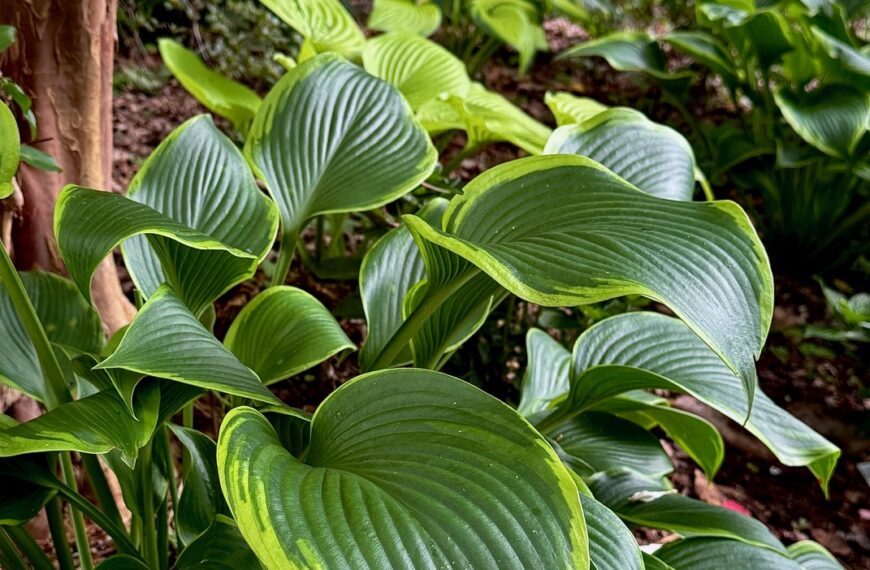
The vivid gold margins of Shadowland Giant Lone Star hosta open the door for exciting combinations.
I never knew my treasured site on a gentle sloping hill was going to qualify to become the poster photo for the word Shadowlands. As I stopped pruning and allowing the tree canopies to develop, sunlight disappeared down below. I was going to become a shade gardener.
Back in my younger days of my horticultural career, I would laugh while showing photos of gardens with an uncountable number of metal tags sticking out of the soil. We joked about it being a hosta cemetery. Of course, those tags were like a map telling the gardener: beware of planting here, there is a dormant hosta underneath this soil.
Shadowland Giant Lone Star hosta, the star of this column, is as the tag suggests, a large variety. It may reach 28 inches tall with a phenomenal spread potential of 52 inches. The tag further states, the color is a medium green with a vivid gold margin. It’s that margin that opens the door for exciting color combinations. A quick note on how to include hostas in your landscape plans, regardless of the space and size:
5 Ways to Design With Hostas
Hostas can fill empty spaces in a landscape design with flare. Your customer will delight in how it fills the void around large trees and shrubs and softens the edges of lawns and walkways.
While they’re not for the hottest climates, there are quite a few that do very well in zones 8 and 9.
Deer do enjoy eating this plant almost as much as we enjoy looking at it. If deer are an issue, consider planting in containers where you can somewhat control access. Many of the smaller Hostas do quite well in window boxes, too.
Designing with Hostas can be fun. Take a look around and see where you could use a bit of drama. Here are a few ideas to get you started.
-
Massed Hostas Offer Maximum Appeal
The key is balance. One hosta by the dozen is always an effective choice. If, however, you love the look of a hosta "collection," with loads of different varieties, here's a tip: add plenty of solid colors such as blues and greens. It’ll make the more dramatic striped and variegated ones pop even more.
-
Fill Shady Containers
Hostas are perfect plants for pots. They fill a container in no time, and look sophisticated and elegant. Pots can help where deer are an issue, as you can simply move the containers closer to the house.
-
Add Lush Foliage to a Mixed Border
Your clients love blooms. What makes blooming flowers stand out even more? Being surrounded by foliage, especially foliage that amps up the excitement of blooms. The leaves provide high contrast to all the colors and forms around them.
-
Knit Together a Shady Slope
Hostas, once they’ve had a few years to settle in, are surprisingly resilient, and do just fine on a slope. Their spreading roots knit together to help stop soil erosion. And, they keep down weeds.
-
As a Singular Sensation
Some Hostas are just so spectacular they need nothing but room to grow. It could be the supersized leaves or the sheer size of the mature plant. However, it could also be a quirky leaf form or growth habit that catches your eye. Now, back to the Giant Lone Star hosta.
I have paired mine with ColorBlaze Mini Me Chartreuse coleus and other Shadowland hostas like Coast to Coat and Echo the Sun, which have chartreuse-colored foliage.
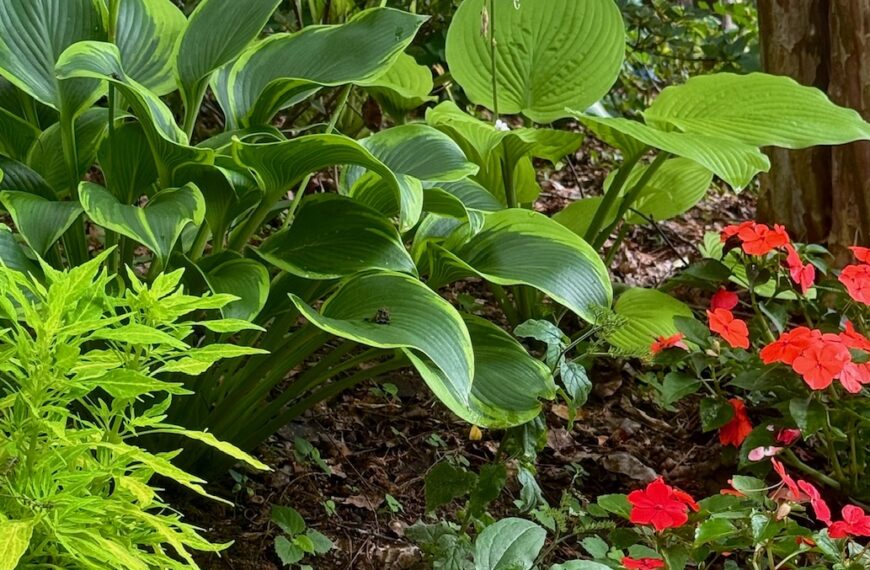
In the foreground, mixed with the Giant Lone Star hosta, I have planted Soprano impatiens. I’ve selected red, oranges and salmon colors but truthfully, any color would work. If I can find them, I will add some violet shades to the mix.
No matter which way you look, you will also see various shades of blue in the background coming from the blooms of hydrangeas. Also in the mix are azaleas, in which case I am hoping for reblooming to sync with hydrangeas and hostas. Regardless, I am having the time of my life.
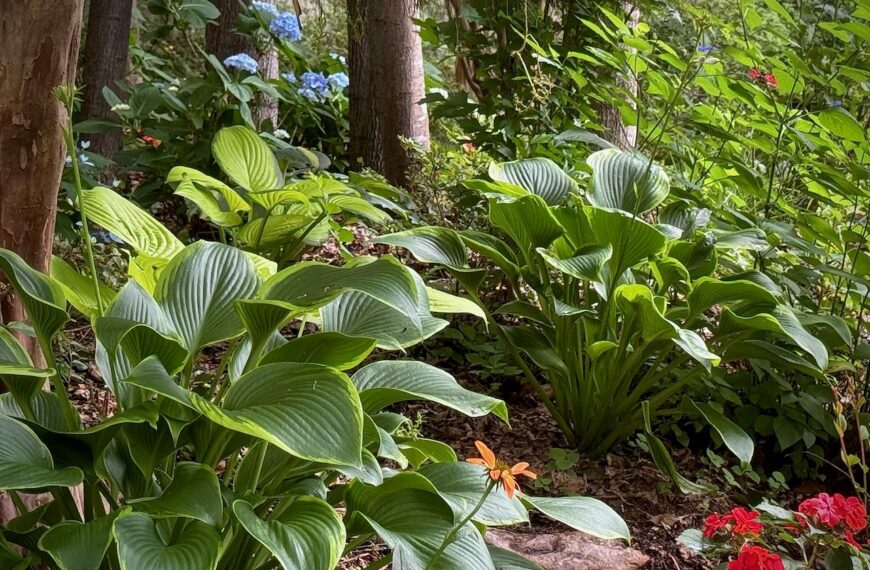
Shadowland Giant Lone Star in the foreground is expected to reach up to 28 inches tall with a phenomenal spread up to 52 inches.
Keep in mind soil fertility when choosing hostas. You may be living where soil is more challenging with pH, and fertility. You too can enjoy hostas, but perhaps the best option is with containers. A Texas A & M publication suggests you can grow a hosta in a container for 5 years before dividing. Be sure to have your container in the right amount of sunlight for your location. In the hot and steamy south, shade will be essential during much of the day.
Here is hoping you, too, will jump on the hosta bandwagon and give your clients the most fun they will ever have gardening. A good place to start is with Shadowland Giant Lone Star.
How to Care for Hostas
- Provide slightly acidic, evenly moist, well-drained, humus soil.
- Apply a balanced, time-release all-purpose fertilizer according to package directions if the soil is poor. Otherwise, topdress with well-rotted manure or compost.
- Avoid harsh sun exposures.
- Water deeply, regularly during the first growing season to establish an extensive root system; reduce frequency once established.
- Remove old, faded foliage before new leaves emerge in early spring.
- Divide every 2 to 3 years in early spring.
Follow me on Facebook @NormanWinterThe GardenGuy for more photos and garden inspiration.
