Many landscape companies use AI as a writing tool. The smarter companies are moving past that.
As a green-industry consulting firm working currently with more than 100 landscape firms, we see AI moving well beyond research and content creation. The most forward-thinking companies are using AI not just to save time, but to work smarter, think and communicate better, and improve overall processes.
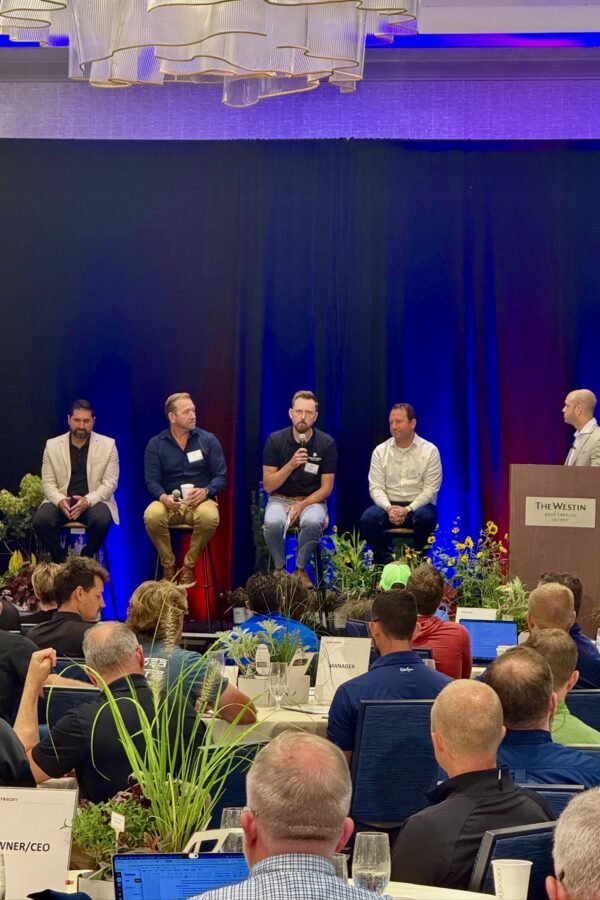
That is why we featured an AI panel at our recent Jeffrey Scott's Summer Growth Summit in August. Here is a combination of what was discussed and what we help our clients achieve.
AI as a Strategic Thought Partner
AI can act as a high-level thought partner for strategic planning.
Feed it context about quarterly goals, sales targets, labor constraints, market opportunities, and leadership gaps. Then ask it to challenge your assumptions, expose blind spots, identify risks, and stress-test your plan before you commit resources.
Instead of asking AI to “write a plan,” ask it to critique your plan. Ask what could go wrong, what assumptions are weak, what risks you are underestimating, and what questions a sharp advisor would ask.
This is where AI becomes more than a convenience tool. It becomes your thought partner.
Better Communication and Processes
Landscape companies often struggle with unclear roles, inconsistent processes, and uneven communication between departments. AI can review internal messages, policy changes, role descriptions, and position agreements for clarity, tone, empathy, and alignment.
If you need to announce a change in scheduling, compensation, production standards, or accountability expectations, AI can help you write the message in a way that is direct but not inflammatory. It can also turn messy management notes into clearer role documents, checklists, and expectations.
Sales and Marketing Support
AI can help landscape companies think through sales strategy and messaging as they expand into new markets.
One client moving into multifamily residential work used AI to think through positioning, sales language, and proposal strategy. Another client, working on a 30-page proposal for a city housing project, used AI as an editor, copywriter, and thought partner to improve the final submission.
The client still brought the expertise, judgment, and local knowledge. But AI helped sharpen the message, organize the proposal, improve the writing, and make the final document stronger.
AI can also support lead capture. An AI voice agent can answer calls when staff are busy, the office is closed, or the team is overwhelmed. It can capture lead information, explain next steps, answer basic questions, and prevent opportunities from dying in voicemail.
AI as a Sales Coach
One of the strongest uses we are seeing is AI-assisted sales coaching.
You can build an AI sales coach by feeding it your sales checklist, required discovery questions, qualification standards, and next-step expectations. Then record a salesperson’s site visit, create a transcript, and have AI score whether they followed the process.
Did they uncover the budget? Identify the decision-maker? Explain the next step? Listen well? Miss an obvious concern?
This turns sales coaching from opinion-based feedback into evidence-based coaching. The sales manager will no longer rely solely on close rates, memory, or the salesperson’s version of the appointment. Note: the ambitious salesperson will use the same tool to critique themselves and improve without waiting to be managed.
Prospect and Client Intelligence
Many landscape companies wish they understood prospects better before the sales call.
AI can help create a short discovery questionnaire that identifies buying preferences. Is the prospect detail-oriented or big-picture? Budget-sensitive or value-driven? Fast-moving or cautious? Hands-on or hands-off?
AI can't perfectly diagnose a client’s personality, but it can allow you to use better questions to understand how a prospect prefers to buy and communicate.
You can also combine client surveys, sales conversations, complaints, design preferences, property history, and account manager notes into richer client profiles. For installation work, this can improve the production handoff. For maintenance work, it can help account managers quickly understand relationship history, prior issues, and communication preferences.
Finance, Collections, and Risk
AI can help leaders review financial information and reduce administrative drag.
You can input financial reports and ask AI to identify patterns, anomalies, and questions management may have overlooked. It can help a bookkeeper, controller, or CEO spot margin changes, labor overruns, revenue trends, receivable issues, or inconsistencies between departments.
One client used an AI agent to build an automation that prepares and sends weekly A/R collection emails based on how many days an invoice is past due. Once the rules and desired output were clear, the process became repeatable. This can be expanded past AR.
Process automation can greatly enhance your team’s capacity and AI can help build almost any automation you can think of.
AI can also help review customer contracts. It should not replace your attorney. But it can summarize issues, flag unusual terms, and rank potential risks by importance.
Estimating and Operations
Estimating is another major opportunity.
You can feed AI your estimating standards, production rates, proposal language, exclusions, material assumptions, scope descriptions, and common questions. That creates a knowledge base that can support faster and smarter estimating.
AI is already being used for takeoffs, and there are companies selling AI-supported takeoff services. This will only improve.
Helping Managers See More
AI can also help managers see what is really happening before small issues turn into bigger problems.
For example, AI can summarize sales appointments, account manager updates, customer complaints, job-cost results, crew notes, and follow-up tasks. It can help a manager quickly see patterns: where salespeople are skipping discovery steps, where account managers are hearing repeated complaints, where jobs are drifting over budget, or where a crew leader may need coaching.
This matters because managers are often forced to coach from incomplete information. They see the final result—a lost sale, an unhappy client, a blown labor budget—but they do not always see the behaviors, conversations, decisions, or handoffs that created that result.
AI helps close that gap. It gives managers better visibility into the inputs, not just the outcomes.
SOPs and the Company Brain
The mistake is asking AI to invent a generic SOP. The better approach is to create what one client calls an “SOP Architect.” You would give the AI a template for standard operating procedures (you can use AI to create that first) and then use real operational knowledge from your people to create a document that aligns with other company documentation.
The “SOP Architect” can interview employees, ask follow-up questions, identify missing steps, and turn their knowledge into a practical first draft.
This can be done for almost any repeatable process: opening the yard, closing out a job, preparing trucks, handling warranty calls, onboarding a crew leader, processing change orders, or completing a production handoff.
One of the most important uses is building a company brain. The COO of Granum spoke on our AI panel and referenced Glean, an enterprise software that connects internal documentation, training materials, and company knowledge so employees can get answers faster and onboard more effectively.
A custom GPT loaded with your SOPs, training documents, templates, contracts, checklists, and internal standards can create a similar advantage, as long as the information is organized and maintained.
Connecting Separate Systems
Some companies are using AI to move information between disconnected applications.
AI can summarize call transcripts into CRM notes, move approved proposal details into production handoffs, turn meeting notes into assigned tasks, trigger collection emails from invoice aging, or alert managers when job-cost results fall outside target.
This is where AI becomes more than a chatbot. It becomes part of the company’s operating system.
Your Challenge
AI is not going to replace good people, but it will help your team make better decisions, move faster, communicate more clearly, and execute with greater consistency. It can also help your company grow faster without a hiring binge.
If you are unsure where to start, pick one painful, repeatable process. Do not automate it yet. First, work with your team to simplify it. Remove unnecessary steps. Reduce handoffs. Clarify who owns the decision. Then teach AI the rules, test the output, keep a human in the loop, and build a better AI-enabled process.
The goal is not to automate waste. The goal is to improve the work while using AI to make the improved process faster, more consistent, and easier to scale. Sometimes AI will totally revamp the process, and sometimes it will simply speed it up and semi/automate it.
Still wondering how to get started? We have a $4M client (member of our Leader's Edge peer group) who recently hired an AI intern whose sole focus is to help enable AI across the company.
The smartest companies are not waiting; they are learning how to use it now.
For more information on our Leader's Edge peer group, where we help contractors accelerate their growth, profitability and use of AI to achieve both, go to JeffreyScott.biz.