Bullet Points from the 2026 Sod Producers Inventory Survey
1. 2026 could be a year that external factors alter early and late season prices.
2. Supply of bermudagrass and zoysiagrass are strong entering the 2026 growing season.
3. Freight rates start the year down relative to previous years.
4. A 5.0-cent per square foot price for certified sod, that ensures genetic purity and free of
noxious weeds, should be expected.
5. 2026 is a year that growers are seriously considering expanding their production
capabilities.
Clint Waltz
The University of Georgia
The Georgia Urban Ag Council conducted their twenty-seventh survey of Georgia sod
producers. The purpose of the survey was to determine the status of inventory levels and
projected price changes for spring and early summer 2026. This year, 19 producers participated
in the survey, representing farm sizes which were less than 300 acres (6 participants), 300 to 600
acres (4 participants), 601 to 900 acres (1 participants), and more than 900 acres (8 participants).
The survey obtained estimates of the inventory for bermudagrass, zoysiagrass,
centipedegrass, St. Augustinegrass, and tall fescue based on estimated sales for 2026 as excellent
(more than 10% of demand), adequate (equal to demand), and poor (more than 10% shortage).
Pricing information included farm price and price for truckload orders to the Atlanta area or
within 100 miles of the farm, all costs were reported as price per square foot of sod.
Inventory Levels
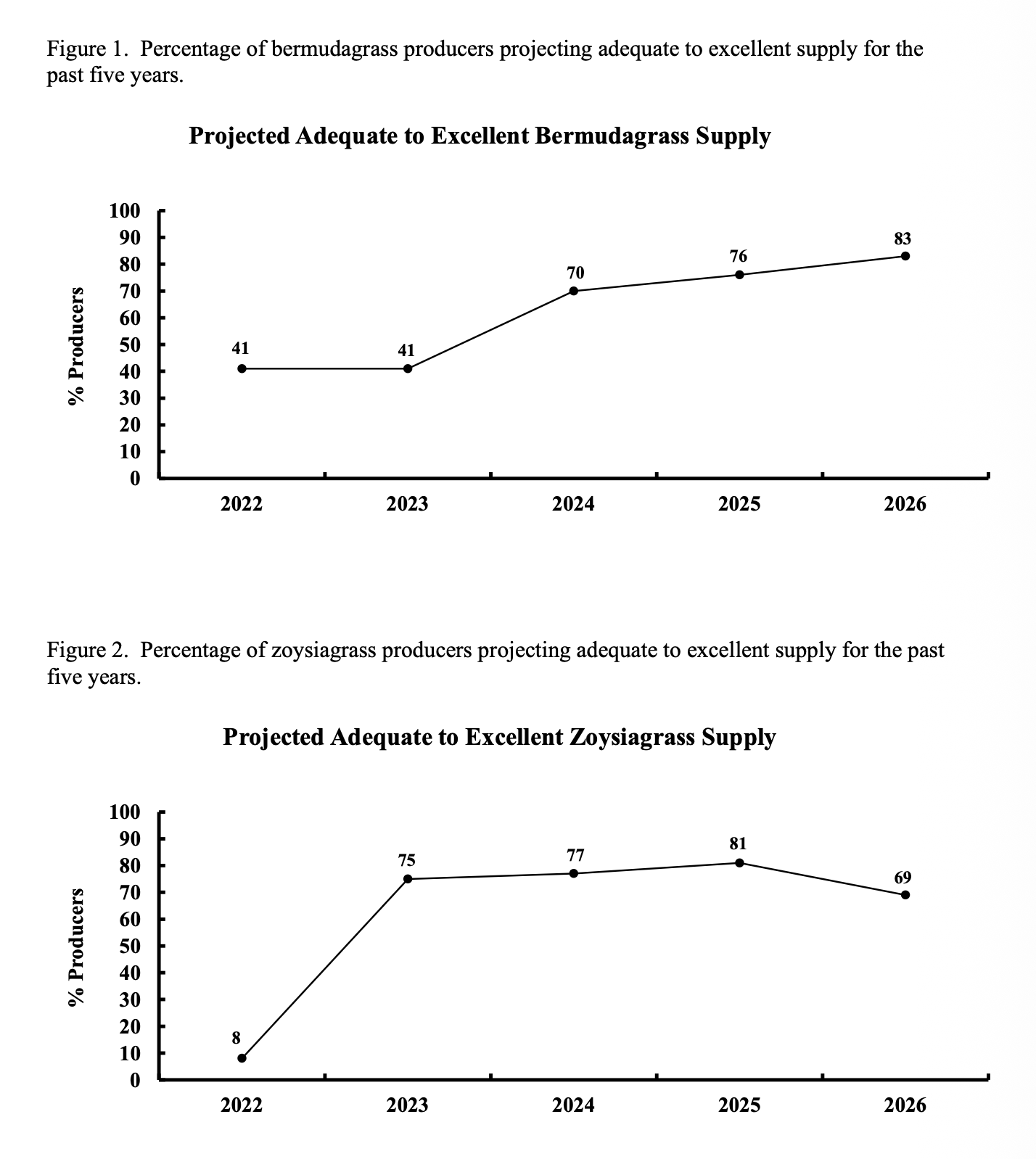
Bermudagrass is being grown by 18 of the surveyed producers. Eighty-three percent of
the producers rated their inventory as adequate to excellent this year (Figure 1). Eighty-nine
percent of the growers with greater than 600 acres in turfgrass production forecast adequate to
excellent supply. Similarly, a majority of growers with less than 600 acres predict having an
“adequate” supply of bermudagrass. For 2026, it would be expected that bermudagrass supply
will meet market demand.
The number of producers growing zoysiagrass (84%) was higher than previous surveys.
Zoysiagrass is a popular species with many commercially available cultivars. There are at least
fourteen zoysiagrass cultivars being grown in Georgia. While zoysiagrass levels appear to be
good in 2026, the projected inventory declined relative to the previous three years (Figure 2).2
Sixty-nine percent of all growers forecast an adequate to excellent zoysiagrass supply in 2026.
All growers with greater than 900 acres in total production forecast adequate to excellent supply
to begin the growing season.
Of the 23 producers surveyed, 12 (63%) were growers of centipedegrass. Sixty-seven
percent of the growers had adequate to excellent inventory compared to 71% in 2025, and 72% in
2024. Of the larger growers, 86% expect an adequate centipedegrass supply.
St. Augustinegrass is being grown by 6 of the 19 producers surveyed. Like last year, half
reported an excellent to adequate supply. Because of environmental conditions, St.
Augustinegrass is difficult to produce in Georgia where our producers have difficulty efficiently
“lifting” sod until mid-June.
Similar to previous years, tall fescue was grown by 37% of producers. Seventy-one of
Georgia’s tall fescue producers reported adequate to excellent inventory. Of the four 900+
-acre
producers, 75% anticipate adequate to excellent supply of tall fescue.
Sod Prices
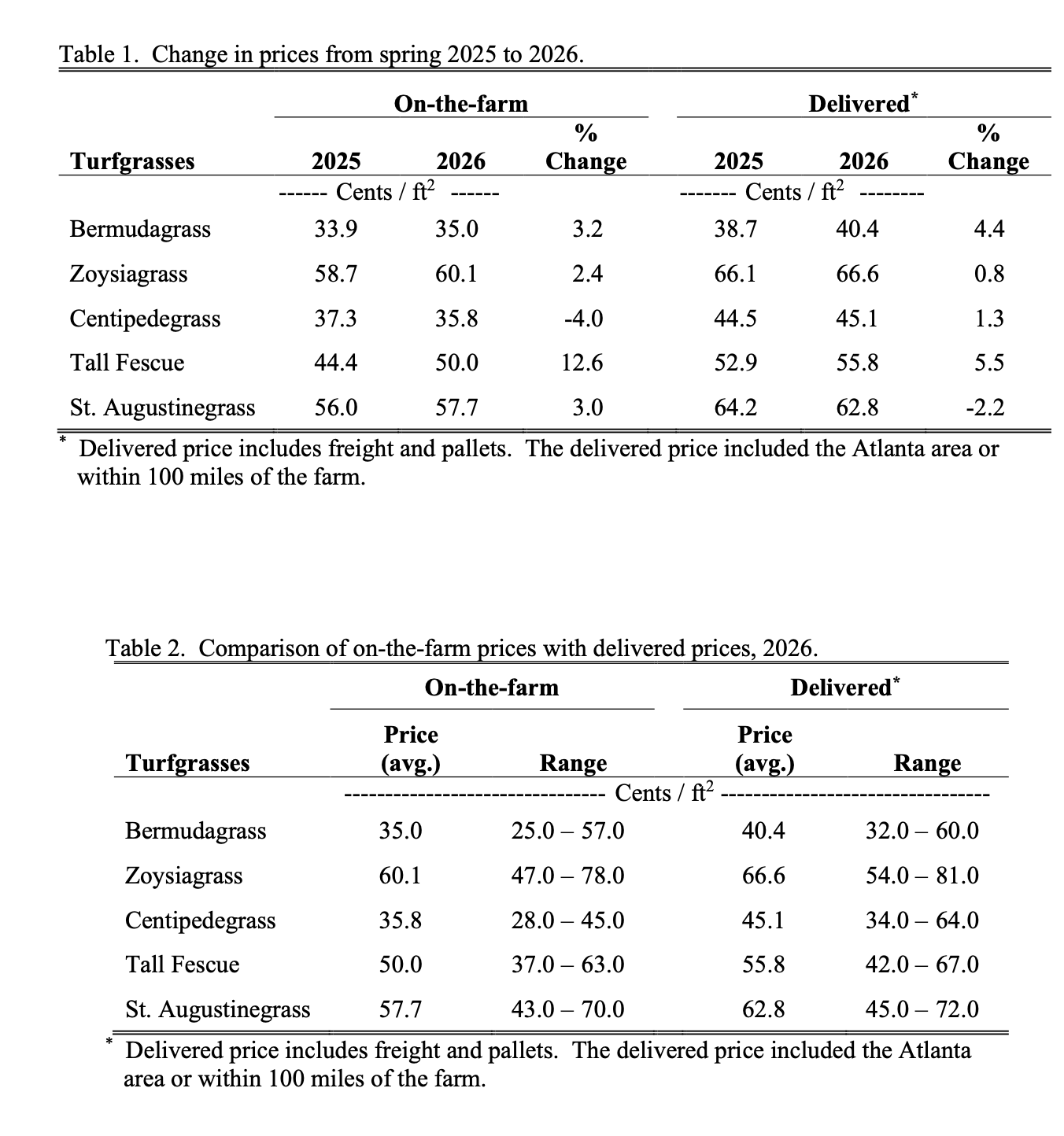
Expect the on-the-farm and delivered prices to be higher in 2026. With exception of on-
the-farm centipedegrass and delivered St. Augustinegrass, all prices increased this year (Table 1).
Price increases ranged from less than 1% to greater than 4% compared to 2025 prices for
delivered bermudagrass and zoysiagrass. Centipedegrass and tall fescue are expected to increase
this year. However, centipedegrass picked-up from the farm may be down (4%) from 2025.
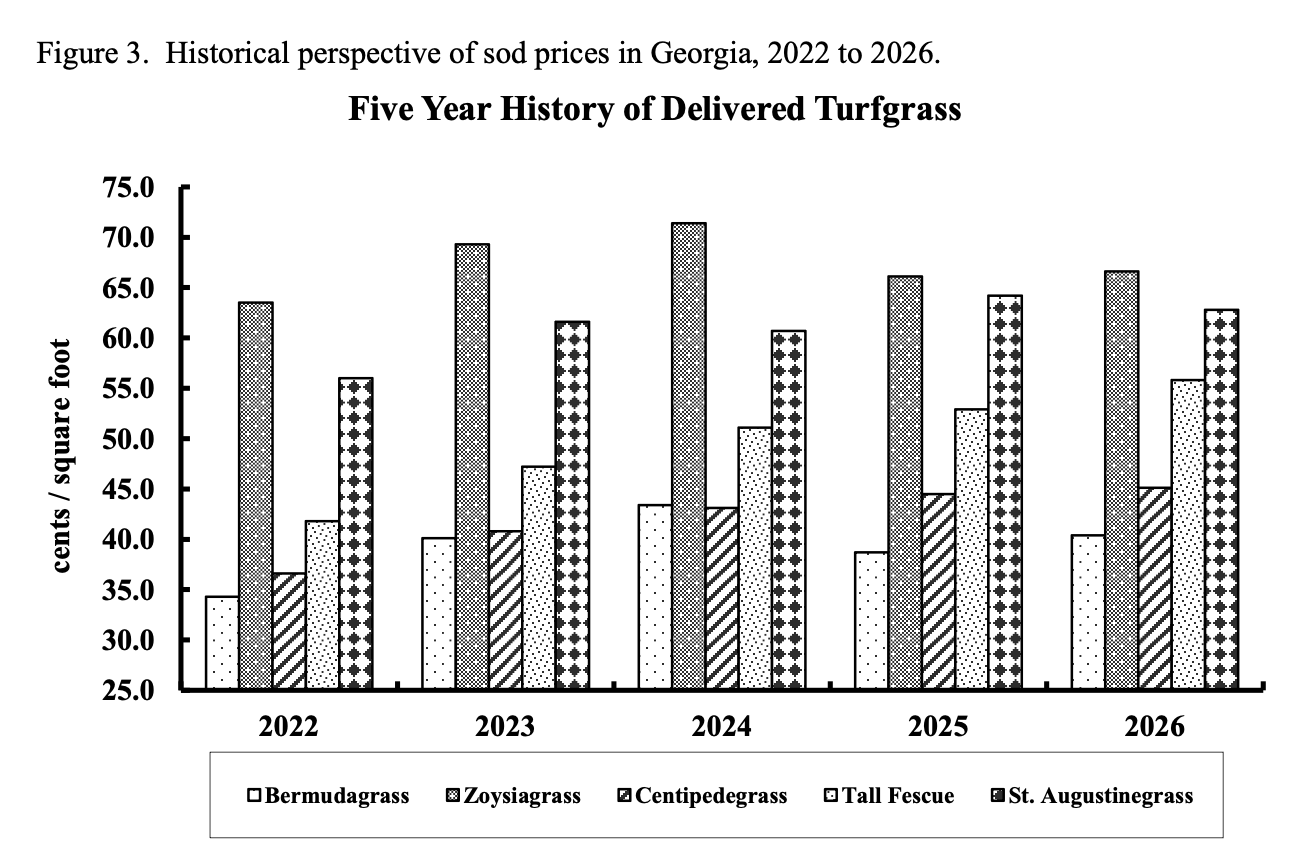
Figure 3 provides a five-year perspective of delivered sod prices. For 2026,
centipedegrass and tall fescue where at their highest prices over the previous five years, and likely
highest prices ever reported for our survey.
The average price per square foot for a truckload of bermudagrass delivered to the Atlanta
area, or within 100 miles of the farm, was higher relative to 2025 (Table 1). The 2026 survey3
indicated prices varied from 32.0 cents to 60.0 cents, with an average price of 40.4 cents (Table
2). The average price in 2025 was 38.7 cents per square foot and ranged from 24.0 cents to 57.0
cents.
The 2026 average price for a delivered truckload of zoysiagrass was about the same as
2025 levels. The average price of delivered zoysiagrass in 2026 was 66.6 cents and ranged from
54.0 to 81.0 cents. In 2025 zoysiagrass prices ranged from 45.0 to 96.0 cents and averaged 66.1
cents.
Centipedegrass prices in 2026 ranged from 34.0 cents to 64.0 cents and averaged 45.1
cents, compared to 2025 when the average delivered price was 44.5 cents and ranged from 26.0 to
70.0 cents.
The 2026 average delivered price for tall fescue (55.8 cents) was 5.5% higher than 2025
(52.9 cents). This year, prices ranged from 42.0 cents to 67.0 cents.
The average price of delivered St. Augustinegrass in 2026 was 62.8 cents and ranged from
42.0 to 67.0 cents. In 2025, St. Augustinegrass prices ranged from 45.0 to 73.0 cents and
averaged 64.2 cents.
Through the years there has been some discussion regarding price discrepancies between
growers with fewer acres and those with many. The assumption has been that the prices charged
by the larger growers are more influential to the reported average in this survey than the prices
reported by group 1 and 2 growers. If an adjustment (i.e. 35% increase) was made to a reported
price that was below one standard deviation from the mean of the larger grower’s price (2 of 8
growers), delivered bermudagrass in 2026 may be closer to 41.6 cents per square foot.
Interestingly, this year there was one, group 4 grower that should have received a 35% upward
price adjustments to fulfill the one standard deviation from the mean criteria.4
Regarding grower price expectations, the general sentiment is prices will hold steady
throughout 2026. Relative to 2025 however, more producers are forecasting price increases for
all grass species as we move through 2026. Fluctuation of pricing is typical throughout the
growing season, but this could be a year that early season grassing projects are less expensive
than late-season projects.
Certification
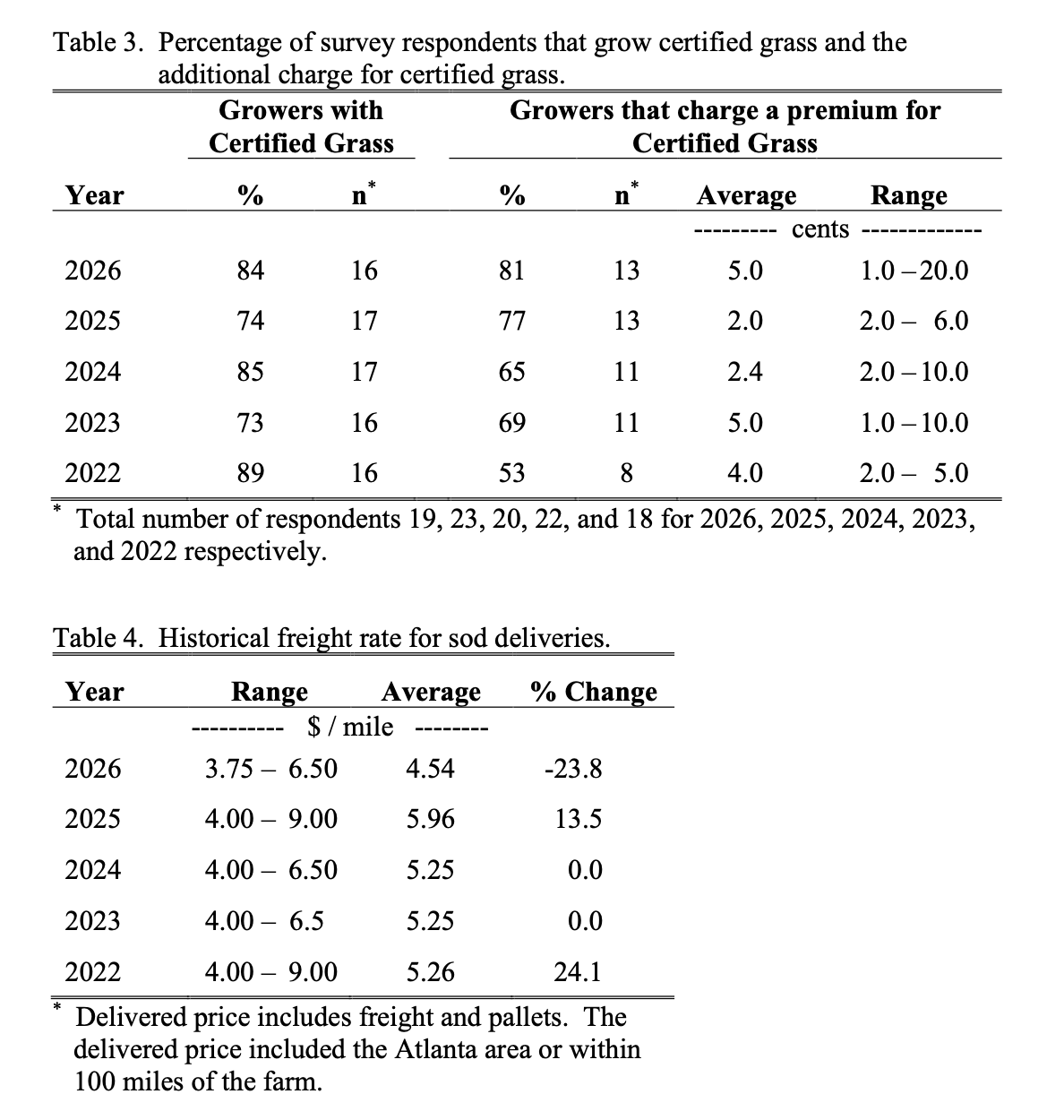
2026 had 16 producers representing 84% of the respondents with some certified grass on
their farm (Table 3). Up from the previous four years, 81% of these growers charge a premium
for certified grass. The remaining growers either do not place an added value on certified sod or
do not participate in the certification program. In 2026, the typical extra cost ranged from 1.0 to
20.0 cents per square foot and averaged 5.0 cents. This translates to between $5.00 and $100.00
on a 500 square foot pallet.
The price point where consumers (i.e. industry practitioners and homeowners) value
varietal purity is unknown. Anecdotal estimates – informal survey of a several hundred
participants – of homeowners and end-consumers suggests the value of a certified grass is likely
within the reported average for this year’s survey. When made aware of the benefits of certified
sod, end-users indicated they are willing to pay at least $25 / 500 square foot pallet to ensure
varietal purity.
Freight, Unloading Fees, and Fuel Surcharge
In 2026 a freight rate which is variable and based on milage, was the pricing structure for
about half of the respondents. The remaining half of the producers charge a flat, or single fixed,
rate for grass deliveries.
2026 freight rates per mile shipped to Atlanta, or within 100 miles of the farm, was down
from 2025 (Table 4). This year, costs ranged from $3.75 to $6.50 and averaged $4.54, down 24%5
from last year.
For growers that charge flat rates, this year’s average charge was $184. Last year was the
first year following the refinement of this question. The result was a wide range in rates ($95 to
$1,200). In 2026, the range were $50 to $350 and probably more reflective of the actual delivery
charges.
If an unloading fee is charged, it may range from $125 to $150. All producers will make
additional drops on a load. The range ($40 to $225) was about the same as last year’s survey, the
average cost for additional drops in 2026 was $106.
Markets
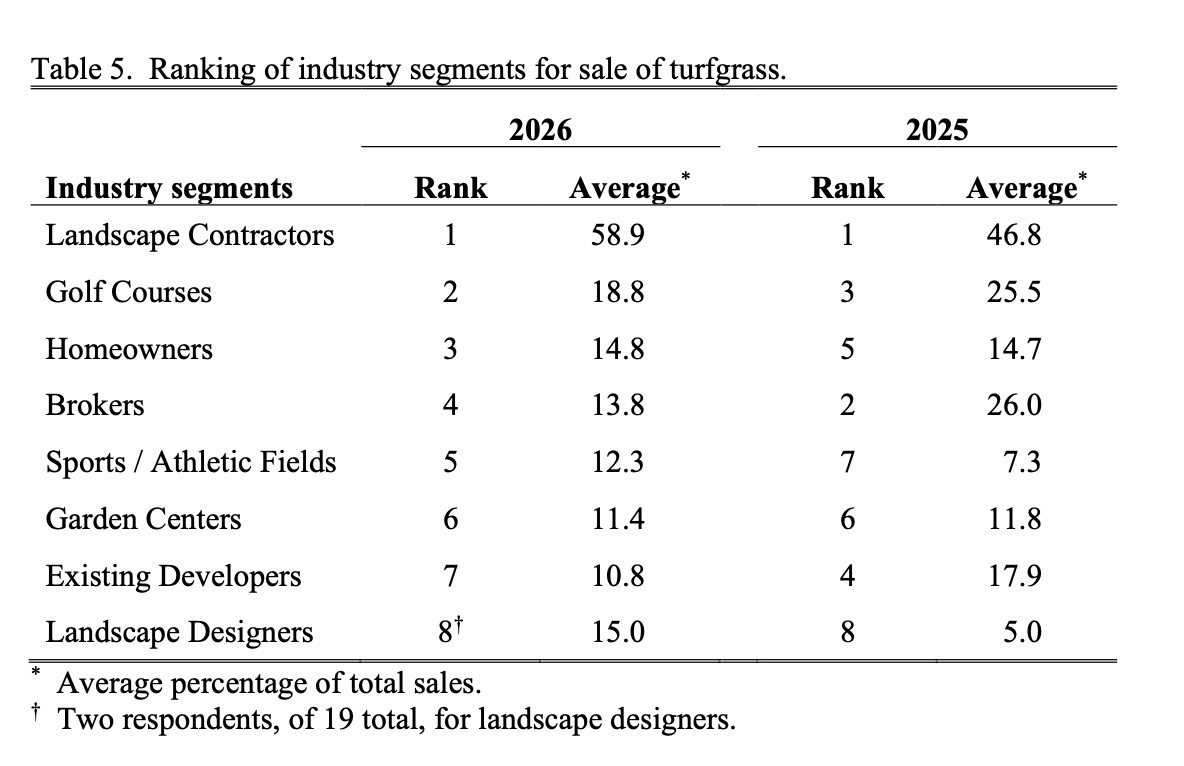
The 19 producers that participated in this survey estimated that 59% of the grass sold was
to landscape contractors (Table 5). This industry segment continues to be the perennial leader
and is consistent with national trends where landscape contractors are the largest marketing
channel for horticulture and specialty crops
(www.nass.usda.gov/Publications/Highlights/2020/census-horticulture.pdf).
Golf courses moved up to the second position, accounting for 19% of expected sales in
2026. It appears that on-course upgrades, renovations, and new course constructions will
continue throughout the year.
Existing developers fell from the 4th rank last year to the 7th this year. This survey is
likely not a good barometer of the new housing market, but this decline could be a sign of
declining housing starts.
Acreage in Production
Doubling from last year, 68% percent of the surveyed producers indicated they planned to
add acres into production during 2026. This year’s increase could be over 900 acres, a healthy
increase from the past two years. This survey is more optimistic for industry growth than the6
Georgia Crop Improvement Association’s “Turfgrass Buyers Guide” (www.georgiacrop.com/turf-
grass) that forecast fewer certified acres in 2026 than 2025.
Summary
The continued in-field supply of bermudagrass and zoysiagrass is encouraging and likely a
factor in stable pricing. While adding acres into production is expected to continue during 2026,
any newly planted fields will not be reflected in this survey for another year to two.
Sod production is a cropping system unlike the rest of the turfgrass industry (i.e.
maintenance) and has its own market drivers. While there is grower optimism that sod prices will
remain steady, there are geopolitical factors with an indeterminate timeline that could change this
perspective. Unlike many commodities, individual sod producers have the ability to alter their
pricing based on these factors resulting in abrupt adjustments up or down. End users (Table 5)
should compare prices while considering all the aspects of purchasing grass (i.e. certified sod,
delivery charges, customer service, warranties, etc.).