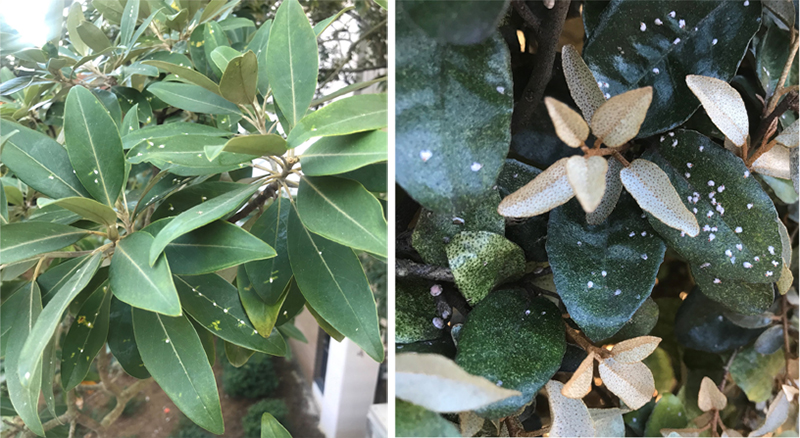
Photo above: Fig. 1. False oleander scale. Photo credit: Shimat V. Joseph, University of Georgia Griffin
The false oleander scale, Pseudaulacaspis cockerelli (Fig. 1 above), is an invasive, armored scale native to China. It is prevalent in Georgia and poses a significant threat as a pest in ornamental nurseries.
False oleander scale primarily infests the leaves of plants, appearing as white spots (Fig. 2 below). As armored scales, they spend their entire lives inserting their tubular, hair-like mouthparts into plant tissue. They do not secrete honeydew; as a result, the leaves do not become coated with sooty mold fungus.
The second and third nymphal stages and adults of false oleander scale secrete wax that forms a protective shell covering. This shell can detach from the scale’s body. The size of the female scale may vary depending on the host species. Unlike other insects, false oleander scale lacks legs, eyes, and antennae.
Life cycle
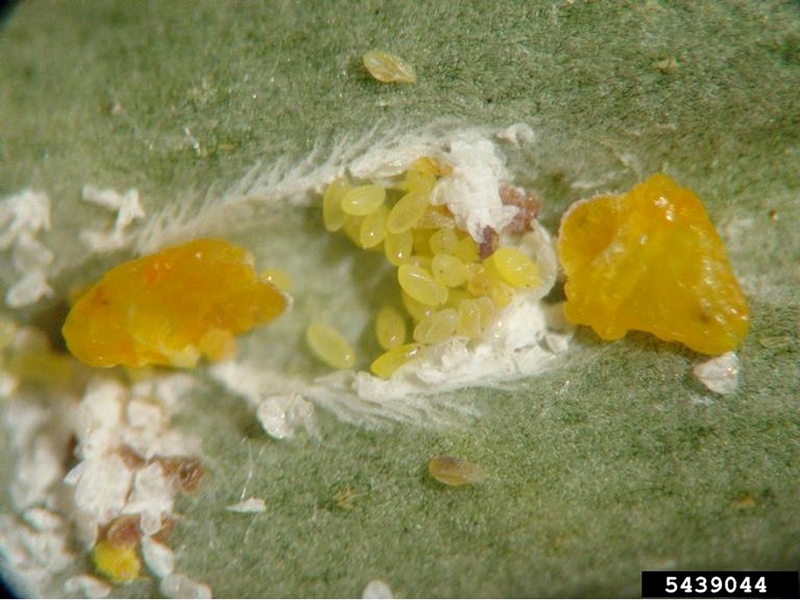
False oleander scale undergoes several generations each year. A female lays about 20 eggs within the shell covering. The eggs are oval-shaped and yellow (Fig. 3 below).
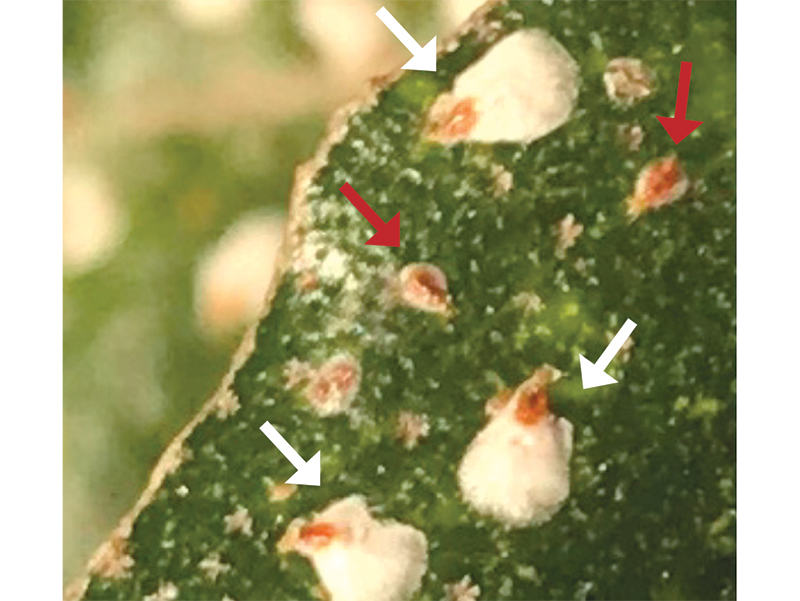
Crawlers, the first nymphal stage, are the only mobile stage of false oleander scale, emerging from mid-April to early May. Crawlers emerge from the eggs within 2-3 days during the summer. They move away from the female, wander randomly, and settle on the leaf surface after inserting their hair-like mouthparts to feed on plant sap. Crawlers are typically dispersed by people, animals, birds, ants, and wind currents. Once settled, they molt into the second instar, shed their legs, and begin secreting shell coverings (Fig. 4 below).
Adult females, measuring less than 1/8 inch (2-3 mm), are typically found on the upper surface of leaves beneath flat, pear-shaped shell coverings (Fig. 4 below). The pointed end of the female is yellowish-brown (Fig. 4 below).
Males are located on the undersides of the leaves and appear elongated (approximately 1 mm), featuring three elongated ridges and snowy white coverings. Males tend to cluster together. Generally, the period from egg to adult takes about a month in the summer.
Host plants
False oleander scale has a wide host range, as it can infest over 100 plant species.
It is commonly found in landscapes on the southern magnolia (Magnolia grandiflora). Other common hosts include aucuba (Aucuba japonica), boxwood (Buxus sempervirens), oleander (Nerium oleander), banana shrub (Magnolia figo), sago palm (Cycas revoluta), cycads (Cycas spp.), gardenia (Gardenia jasminoides), English ivy (Hedera helix), bischofia (Bischofia javanica), camellia (Camellia japonica), and palmetto (Sabal palmetto).
Damage
The affected leaves will develop yellow or chlorotic spots (Fig. 5 below), resulting in delayed growth and development. As the population size increases, the leaves drop, causing stunted plant growth. False oleander scale typically remains on older foliage.
Management
When introducing new plant material from other nursery facilities, it is crucial to inspect for false oleander scale infestations before integrating it with the existing nursery stock.
All stages of false oleander scale can be found in the summer.
Contact insecticides, such as pyrethroids, insecticidal soap, and horticultural oil, are effective only on the crawlers. Managing false oleander scale can be challenging when using contact insecticides because they are less effective against nymphal stages and adults, except for crawlers, due to their waxy shells. Crawlers do not have shell coverings. Multiple applications of contact insecticides with adequate coverage are necessary to reduce the population during the summer.
Soil application of systemic insecticides containing dinotefuran (Safari or Zylam) and thiamethoxam (Flagship) in the crown area of the plant or tree can reduce the false oleander scale population. The insecticide residues quickly move through the soil and reach the root system. The roots absorb the residues from the soil and rapidly transport them through the vascular bundles to the leaves where false oleander scale are feeding. They ingest insecticide residues, leading to scale mortality.
Foliar application of imidacloprid also reduces nymph populations eight weeks after treatment. Dead scales remain on the foliage. Additionally, foliar applications of insect growth regulators, such as pyriproxyfen (Distance) and buprofezin (Talus), can suppress false oleander scale populations for up to twenty-eight days.